
FADP compliance for Swiss corporate groups, built by a Swiss team and hosted in Switzerland















Everything you need for Swiss FADP compliance

Processing Records
The processing record must document:
 The identity and contact details of the controller (and any joint controllers)
-
The purposes of data processing
-
The categories of data subjects and personal data processed
-
The categories of recipients, including data transfers abroad
-
The retention periods, if known
-
A general description of data security measures
-
The basis of justification (e.g., consent, overriding private/public interest, legal duty)
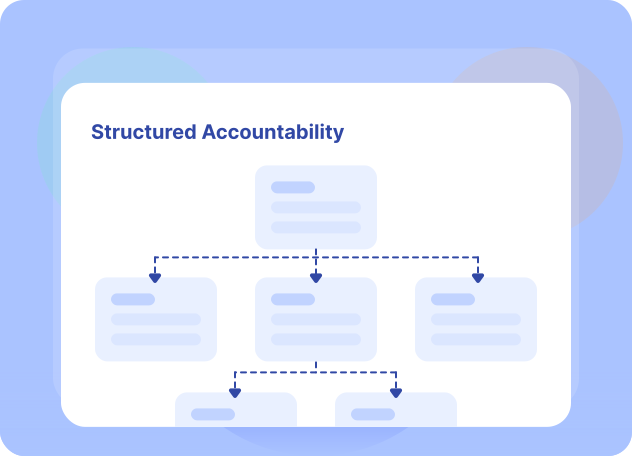
Governance and Accountability Documents
This document demonstrates implementation of the accountability principle and defines how data protection is integrated into daily operations.
Complementary training logs, internal audits, and data protection governance records show ongoing awareness and oversight.
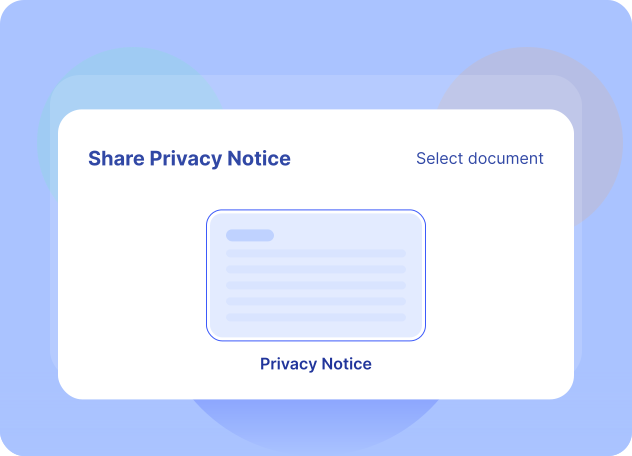
Transparency and Communication Documents
-
Identity of the controller and purposes of processing
-
Recipients and transfer details
-
Rights of data subjects
-
Automated decision-making, if applicable
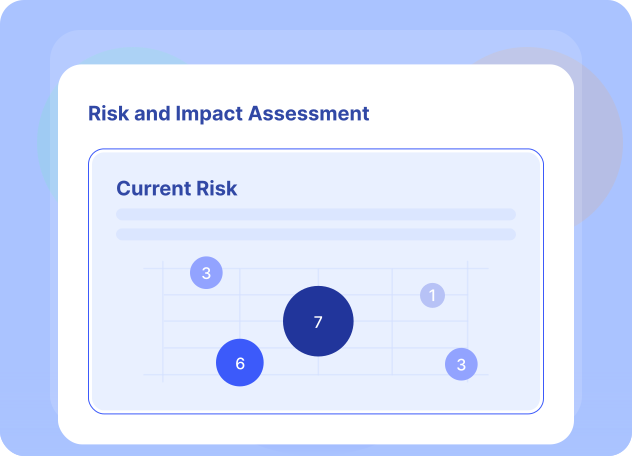
Risk and Impact Assessment Documents
A DPIA Register or documentation file should include:
-
Description of processing and risks
-
Assessment of necessity and proportionality
-
Measures to mitigate risks
-
Evidence of consultation with the FDPIC if required
Processor and Third-Party Management Documents
A Processor Contract Register should record:
-
Processor identities and purposes
-
Key contractual clauses ensuring compliance
-
Any cross-border subcontractors
Security and Incident Management Documents
Controllers must also maintain a Data Breach Register to document all personal data breaches, including:
-
Date, nature, and scope of the breach
-
Risk assessment and mitigating actions
-
Notifications made to the FDPIC and affected persons
Cross-Border Transfer Documentation
-
The destination country and legal safeguard used (e.g., standard clauses, consent, overriding interest)
-
The Transfer Impact Assessment (TIA) if risks exist
Your data stays in Switzerland. Your DPA is governed by Swiss law.

Ready to simplify your privacy management?
▸ About this page: references, definitions, and FAQs
Key Takeaways: Swiss FADP Compliance with Priverion
The revised Swiss Federal Act on Data Protection (FADP/nDSG), in force since 1 September 2023, requires controllers to maintain processing records, conduct DPIAs for high-risk activities, notify the FDPIC of serious breaches, and document cross-border transfers with adequate safeguards. Priverion is a Swiss-hosted SaaS platform that automates all seven compliance areas (ROPA, governance, privacy notices, DPIAs, vendor management, breach notification, and cross-border transfers) under both the FADP and the EU GDPR in a single workspace.
What is the Swiss FADP (nDSG)?
The Swiss Federal Act on Data Protection (FADP), known in German as the Datenschutzgesetz (DSG), is Switzerland's primary data protection statute. The fully revised version entered into force on 1 September 2023, replacing the 1992 law. It aligns Swiss data protection more closely with the EU GDPR while retaining Swiss-specific features such as individual criminal liability and the FDPIC's advisory enforcement model. The full consolidated text is available at fedlex.admin.ch.
How does the revised FADP differ from the EU GDPR?
While both frameworks share core principles (lawfulness, purpose limitation, data minimisation, and accountability) key differences exist. The FADP does not include a "legitimate interest" legal basis; instead, Swiss law permits processing based on "overriding private or public interest" (Art. 31 FADP). Criminal fines under Art. 60 to 63 FADP target responsible individuals (up to CHF 250,000), not the organisation. The FDPIC issues recommendations rather than binding orders with direct fines. According to the IAPP, this individual-liability model is unique among major data protection regimes globally.
Who must comply with the Swiss FADP?
All private persons and federal bodies processing personal data of individuals in Switzerland must comply. The FADP applies extraterritorially: foreign companies whose processing produces effects in Switzerland are also subject to the law (Art. 3 para. 1 FADP). The FDPIC (Federal Data Protection and Information Commissioner) supervises compliance and publishes guidance for both domestic and foreign controllers.
What is a DPIA under the Swiss FADP?
Under Art. 22 FADP, a Data Protection Impact Assessment must be conducted when planned processing is likely to pose a high risk to the personality or fundamental rights of data subjects. The assessment must describe the processing, evaluate necessity and proportionality, identify risks, and document mitigation measures. If residual high risk remains after mitigation, the controller must consult the FDPIC before proceeding (Art. 23 FADP). The EDPB's DPIA guidelines, while EU-focused, are widely referenced by Swiss practitioners as methodological guidance (EDPB Guidelines 4/2017).
What are the breach notification requirements under the FADP?
Art. 24 FADP requires controllers to notify the FDPIC "as quickly as possible" of personal data breaches that pose a high risk. The FDPIC recommends a 72-hour notification window, consistent with GDPR practice. Affected data subjects must also be informed when necessary for their protection. A documented breach register, recording date, nature, scope, risk assessment, and remedial actions, is essential evidence of compliance.
What are the penalties for FADP non-compliance?
Intentional violations of key obligations, including failure to provide information (Art. 60), failure to cooperate with the FDPIC (Art. 63), and breach of professional secrecy (Art. 62), carry fines of up to CHF 250,000 against the responsible individual. According to a 2024 survey by IAPP, 68% of Swiss privacy professionals reported that the individual-liability model has increased board-level attention to data protection compliance.
How does Priverion automate FADP compliance?
Priverion maps every processing activity to both the Swiss FADP and the EU GDPR simultaneously. The platform automates Record of Processing Activities (ROPA) with Swiss-specific minimum content fields, generates FDPIC-ready DPIA documentation, tracks processor contracts and subprocessor chains, manages breach notification timelines, and documents cross-border transfers with Transfer Impact Assessments (TIAs) under Art. 16 to 17 FADP. All data is hosted in Switzerland with full Swiss data residency, on an ISMS aligned with ISO 27001.
Statistics and Context
According to the IAPP-EY 2023 Privacy Governance Report, the average organisation spends approximately 54% of its privacy budget on operational compliance tasks such as ROPA maintenance, DPIA execution, and vendor assessments. A 2024 Gartner forecast projects that by 2026, 60% of large enterprises will use automated privacy management platforms, up from fewer than 15% in 2021. The FDPIC's 2023 to 2024 activity report noted a significant increase in consultation requests following the revised FADP's entry into force, underscoring the compliance burden on Swiss organisations. ENISA's 2023 threat landscape report (ENISA) identified ransomware and supply-chain attacks as the top threats to personal data, reinforcing the importance of robust breach notification and vendor management processes.
FADP vs GDPR: Comparison Table
| Aspect | Swiss FADP (nDSG) | EU GDPR |
|---|---|---|
| Effective date | 1 September 2023 | 25 May 2018 |
| Scope | Natural persons in Switzerland; extraterritorial | Natural persons in EEA; extraterritorial |
| Supervisory authority | FDPIC (advisory/recommendation powers) | National DPAs (binding orders, direct fines) |
| Maximum fine | CHF 250,000 (individual) | € 20 million or 4% global turnover (organisation) |
| Legal basis for processing | Overriding private/public interest, consent, legal duty | Legitimate interest, consent, contract, legal obligation, vital interest, public task |
| DPIA required | Yes (Art. 22 FADP) | Yes (Art. 35 GDPR) |
| Breach notification | FDPIC, as quickly as possible (72 h recommended) | DPA within 72 hours (Art. 33 GDPR) |
| DPO requirement | Optional (Data Protection Advisor) | Mandatory in certain cases (Art. 37 GDPR) |
| Cross-border transfers | Art. 16 to 17 FADP; Federal Council adequacy list | Art. 44 to 49 GDPR; EU Commission adequacy decisions |