

GDPR compliance for corporate groups: from GAP analysis to audit-ready















Everything you need for GDPR accountability

ROPA (Art. 30 GDPR)

Transparency and Communication Documents
Risk and Impact Assessment Documents
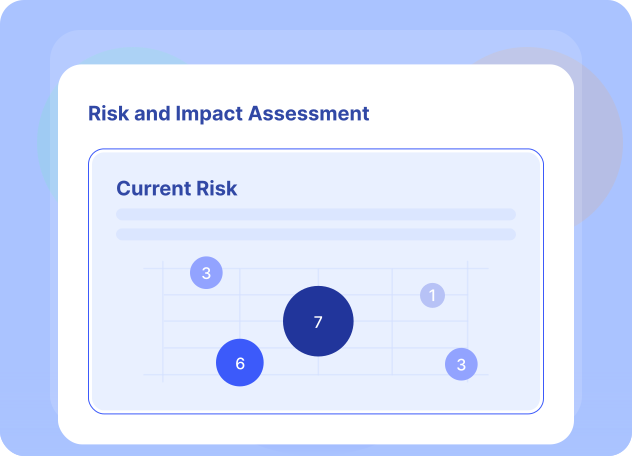
A DPIA Register records when and how such assessments were carried out, including identified risks and mitigation measures. For international data transfers, Transfer Impact Assessments (TIAs) and Standard Contractual Clauses (SCC) documentation provide evidence of safeguards and due diligence.
Processor and Third-Party Management Documents
This register evidences that processors were selected with sufficient guarantees and that data processing agreements include the required clauses. It should also record any subprocessors or joint controller arrangements.
Security and Incident Management Documents
Complementing this is the Data Breach Register, which records all personal data breaches, actions taken, notifications made, and lessons learned. Together, these documents fulfill obligations under Articles 32 to 34.
Many customers manage GDPR alongside ISO 27001 and Swiss FADP

Ready to simplify your privacy management?
▸ About this page: references, definitions, and FAQs
Key Takeaways
Priverion is a Swiss-hosted GDPR compliance platform purpose-built for multi-entity corporate groups. It automates Records of Processing Activities (ROPA), Data Protection Impact Assessments (DPIAs), data subject requests (DSRs), vendor risk management, and breach notification workflows. All data is stored in ISO 27001-aligned infrastructure in Switzerland. Customers report 75% less manual ROPA upkeep and 3× more work done per DPO.
Definitions
What is GDPR?
GDPR (General Data Protection Regulation) is Regulation (EU) 2016/679 of the European Parliament and of the Council, which governs the processing of personal data of individuals in the EU/EEA. It has applied since 25 May 2018 and imposes obligations on controllers and processors worldwide who handle EU residents' data.
What is a Record of Processing Activities (ROPA)?
A ROPA is a mandatory register under Article 30 GDPR that documents every processing activity, its purpose, legal basis, data categories, recipients, retention periods, and security measures. Both controllers and processors must maintain one.
What is a Data Protection Impact Assessment (DPIA)?
A DPIA is required under Article 35 GDPR when processing is likely to result in a high risk to individuals' rights and freedoms. The EDPB Guidelines 4/2017 provide detailed criteria for when a DPIA is necessary.
What is a Data Processing Agreement (DPA)?
A DPA is a contract required under Article 28 GDPR between a controller and a processor. It must set out the subject-matter, duration, nature, and purpose of processing, the type of personal data, and the obligations of the processor.
What are Standard Contractual Clauses (SCCs)?
SCCs are model contractual clauses approved by the European Commission under Implementing Decision (EU) 2021/914 to provide adequate safeguards for international data transfers under GDPR Chapter V.
GDPR Enforcement Statistics
According to the GDPR Enforcement Tracker, supervisory authorities across the EU/EEA have issued over 2,200 fines since the regulation took effect in May 2018, with cumulative penalties exceeding €4.8 billion. The IAPP-EY 2023 Privacy Governance Report found that the average organisation employs 5.2 full-time privacy staff, yet 60% of privacy leaders report that manual processes remain their biggest operational challenge. A 2024 EDPB coordinated enforcement action on the role of Data Protection Officers found that many organisations still struggle with adequate DPO resourcing and independence.
Frequently Asked Questions
What is a Record of Processing Activities (ROPA) under GDPR?
A Record of Processing Activities (ROPA) is required under Article 30 of the GDPR. It documents all personal data processing operations, including purposes, legal bases, data categories, recipients, retention periods, and technical and organisational security measures. Both controllers and processors must maintain a ROPA. Priverion automates ROPA creation and recertification for multi-entity corporate groups.
What is a Data Protection Impact Assessment (DPIA)?
A DPIA is mandated by Article 35 of the GDPR for processing activities that are likely to result in a high risk to individuals' rights and freedoms. It requires organisations to systematically assess the necessity, proportionality, and risks of the processing, and to identify mitigation measures. The EDPB Guidelines 4/2017 list nine criteria that indicate when a DPIA is required.
How does Priverion help with GDPR compliance for corporate groups?
Priverion connects ROPAs to risk assessments, vendor contracts, and data flows across all group entities. When one element changes, related records update automatically. This eliminates manual spreadsheet work and ensures audit-ready documentation. Customers report 75% less manual ROPA upkeep and 3× more work done per DPO.
Is Priverion data hosted in Switzerland?
Yes. Priverion is Swiss-hosted with ISO 27001-aligned data storage in Switzerland. This provides an additional layer of data sovereignty for organisations concerned about cross-border data transfers under GDPR Chapter V.
What GDPR obligations does vendor management address?
Under Articles 28 and 29 of the GDPR, controllers must ensure that processors provide sufficient guarantees and that data processing agreements include required clauses covering subject-matter, duration, nature, and purpose of processing. Priverion's vendor management module tracks every processor contract, subprocessor, and DPA in one place.
What are the GDPR breach notification requirements?
Under Article 33 of the GDPR, controllers must notify the supervisory authority within 72 hours of becoming aware of a personal data breach, unless the breach is unlikely to result in a risk to individuals. Article 34 requires notification to affected individuals when the breach is likely to result in a high risk. The EDPB Guidelines 9/2022 provide practical examples of breach notification scenarios.
How does GDPR relate to the Swiss Federal Act on Data Protection (FADP)?
The revised Swiss FADP, effective since 1 September 2023, was modernised to align closely with the GDPR. Both laws require records of processing activities, data protection impact assessments, and breach notification. Organisations operating in both the EU and Switzerland can manage both frameworks in Priverion's unified platform.
What role does ISO 27001 play in GDPR compliance?
ISO/IEC 27001 is the international standard for information security management systems (ISMS). While ISO 27001 certification is not required by the GDPR, it provides a structured framework for implementing the technical and organisational measures required under Article 32 GDPR. Priverion's infrastructure is ISO 27001-aligned, and the platform also supports customers' own ISO 27001 compliance programmes.
GDPR Compliance Feature Comparison
| Capability | Manual / Spreadsheet | Priverion Platform |
|---|---|---|
| ROPA management (Art. 30) | Static Excel files, manual updates | Automated, linked to risk assessments and vendor contracts |
| DPIA workflow (Art. 35) | Word templates, weeks to complete | Pre-built templates, AI-assisted risk scoring, hours to complete |
| Data subject requests (Art. 15-22) | Email-based tracking, error-prone | Structured workflow with deadline tracking and audit trail |
| Vendor / processor management (Art. 28) | Scattered contracts, no central view | Centralised register with DPA tracking and subprocessor monitoring |
| Breach management (Art. 33-34) | Ad-hoc documentation | End-to-end workflow from detection to authority notification |
| Cross-framework support | Separate processes per framework | Unified platform for GDPR, Swiss FADP, and ISO 27001 |
| Multi-entity / group support | Duplicated files per entity | Group-wide visibility with entity-level granularity |