
Build your ISMS, prepare for audit, get certified. All in one platform.













7 steps from policy to certification

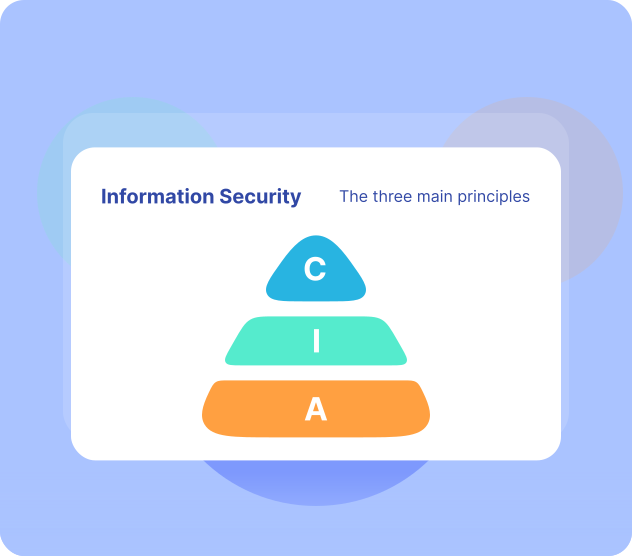
Information Security Policy
Key points:
 Leadership commitment, resource allocation, and accountability.
-
Foundation for risk management and continual improvement (Plan-Do-Check-Act).
-
Defines scope, objectives, and guiding principles/controls.
-
Guides behaviour (roles, responsibilities, incident reporting, acceptable use).
-
Supports compliance with legal, regulatory, and contractual obligations and informs procedures, training, and audits.
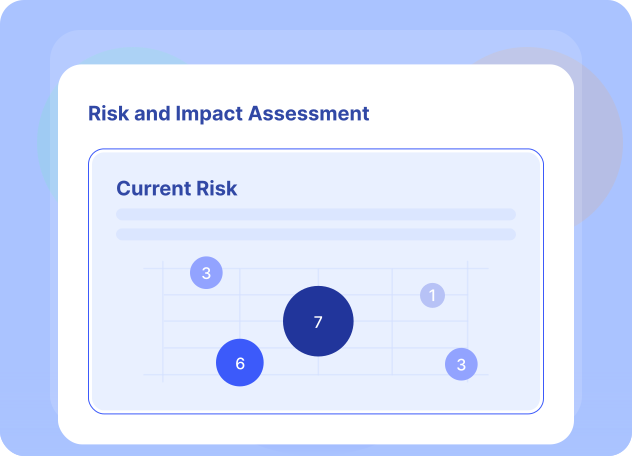
Risk Evaluation
Statement of Applicablity

Risk Treatment Plan
Controls Implementation
Internal Audit
External Audit

ISO 27001 + GDPR + Swiss FADP in one platform

Ready to simplify your privacy management?
▸ About this page: references, definitions, and FAQs
Key Takeaways: ISO 27001 Compliance with Priverion
Priverion is a Swiss-hosted SaaS platform purpose-built for ISO 27001:2022 certification. It automates the full ISMS lifecycle, from information security policy creation and risk evaluation through Statement of Applicability (SoA) generation, risk treatment planning, control implementation tracking, and internal audit management. Organizations using Priverion report saving over 200 hours in audit preparation and achieving 2× faster risk mitigation compared to manual spreadsheet-based approaches. The platform also unifies ISO 27001 with GDPR and Swiss FADP compliance in a single workspace, eliminating duplicate documentation across frameworks.
Definitions
What is an ISMS (Information Security Management System)?
ISMS stands for Information Security Management System. According to ISO/IEC 27001, an ISMS is a systematic approach to managing sensitive company information so that it remains secure. It includes people, processes, and IT systems by applying a risk management process, giving assurance that information security risks are adequately managed.
What is the Statement of Applicability (SoA)?
The Statement of Applicability is a mandatory document required by ISO 27001 Clause 6.1.3(d). It lists all 93 Annex A controls from ISO 27001:2022, indicates whether each is implemented or excluded, and provides justification. The SoA serves as the bridge between risk assessment and control implementation. Source: ISO 27001:2022
What is a Risk Treatment Plan?
A Risk Treatment Plan documents how identified information security risks will be addressed. It specifies chosen controls, responsible owners, timelines, and resources. ISO 27001 Clause 6.1.3 requires organizations to formulate a risk treatment plan and obtain risk owner approval for residual risks.
What are Annex A Controls?
Annex A Controls are the reference set of information security controls in ISO 27001:2022. The 2022 revision consolidated the previous 114 controls (in 14 domains) into 93 controls across four themes: Organizational (37), People (8), Physical (14), and Technological (34). Eleven new controls were introduced, including threat intelligence, cloud security, and data masking. Source: ISO/IEC 27001:2022
Statistics and Industry Context
According to the ISO Survey of Certifications 2023, there were over 70,000 valid ISO/IEC 27001 certificates worldwide, a year-on-year increase of approximately 20%, reflecting growing demand for formalized information security management. The European Union Agency for Cybersecurity (ENISA) has repeatedly recommended ISO 27001 as a baseline framework for organizations seeking to comply with the NIS2 Directive. A 2023 Gartner analysis projected that by 2025, 60% of organizations would use cybersecurity risk as a primary determinant in third-party transactions, making ISO 27001 certification a competitive differentiator. The IAPP-EY 2023 Privacy Governance Report found that 58% of privacy professionals reported increased budgets for compliance technology, underscoring the shift from manual processes to automated platforms.
ISO 27001:2022 vs. ISO 27001:2013: Key Changes
| Aspect | ISO 27001:2013 | ISO 27001:2022 |
|---|---|---|
| Number of Annex A controls | 114 controls in 14 domains | 93 controls in 4 themes |
| New controls introduced | None | 11 new controls (e.g., threat intelligence, cloud security, data masking) |
| Control themes | 14 domains (A.5 to A.18) | 4 themes: Organizational, People, Physical, Technological |
| Attributes for controls | Not included | 5 attributes: control type, security property, cybersecurity concept, operational capability, security domain |
| Transition deadline | Not applicable | 31 October 2025 (all certificates must transition) |
Frequently Asked Questions
What is ISO 27001:2022 and why does it matter?
ISO 27001:2022 is the international standard for information security management systems (ISMS), published by the International Organization for Standardization (ISO) and the International Electrotechnical Commission (IEC). It provides a systematic framework for managing sensitive information through risk assessment, control implementation, and continual improvement. Certification demonstrates to customers, regulators, and partners that an organization meets globally recognized security benchmarks. Under the EU's NIS2 Directive, ENISA recommends ISO 27001 as a baseline compliance framework.
How long does ISO 27001 certification typically take?
ISO 27001 certification typically takes 6 to 12 months depending on organizational maturity, scope, and existing controls. According to industry benchmarks, the documentation phase alone can consume 40 to 60% of total project time. Organizations using dedicated ISMS software like Priverion can reduce documentation effort significantly. Customers report saving 200+ hours in audit preparation based on real-world results.
What is a Statement of Applicability (SoA) in ISO 27001?
The Statement of Applicability (SoA) is a mandatory document required by ISO 27001 Clause 6.1.3(d). It lists all Annex A controls, states whether each is applied or excluded, and provides justification for exclusions. The SoA links risk assessment results to implemented controls and serves as a baseline for internal audits, surveillance audits, and certification decisions.
How does Priverion help with ISO 27001 compliance?
Priverion provides a Swiss-hosted SaaS platform that automates the entire ISMS lifecycle: policy creation with templates, structured risk evaluation with threat-vulnerability pairing, automated SoA generation, risk treatment plan tracking with owners and deadlines, real-time control implementation monitoring, and internal audit management with evidence linking. It replaces spreadsheets with structured workflows and generates auditor-ready reports instantly.
Can Priverion handle ISO 27001 alongside GDPR and Swiss FADP?
Yes. Priverion unifies ISO 27001, GDPR, and Swiss FADP compliance in a single platform. Controls and risk assessments are mapped across all applicable regulations, eliminating duplicate documentation. This integrated approach is particularly valuable for Swiss and European organizations that must demonstrate compliance with multiple overlapping frameworks simultaneously.
What are the 93 Annex A controls in ISO 27001:2022?
ISO 27001:2022 Annex A contains 93 controls organized into four themes: Organizational (37 controls covering policies, roles, asset management, access control, and supplier relationships), People (8 controls for screening, awareness, and disciplinary processes), Physical (14 controls for perimeters, equipment, and environmental threats), and Technological (34 controls for endpoint security, logging, cryptography, secure development, and cloud services). Eleven controls are entirely new compared to the 2013 version. Source: ISO/IEC 27001:2022
What is the transition deadline from ISO 27001:2013 to 2022?
The International Accreditation Forum (IAF) set 31 October 2025 as the deadline for all existing ISO 27001:2013 certificates to transition to the 2022 version. After this date, 2013-version certificates are no longer valid. Organizations should plan their transition audit well in advance to avoid certification gaps.
How does ISO 27001 relate to the NIS2 Directive?
The EU's NIS2 Directive (Directive 2022/2555) requires essential and important entities to implement appropriate cybersecurity risk management measures. ENISA has identified ISO 27001 as a recognized framework that can help organizations demonstrate compliance with NIS2's security requirements. While ISO 27001 certification is not explicitly mandated by NIS2, it provides a structured, auditable approach that aligns closely with the directive's expectations.